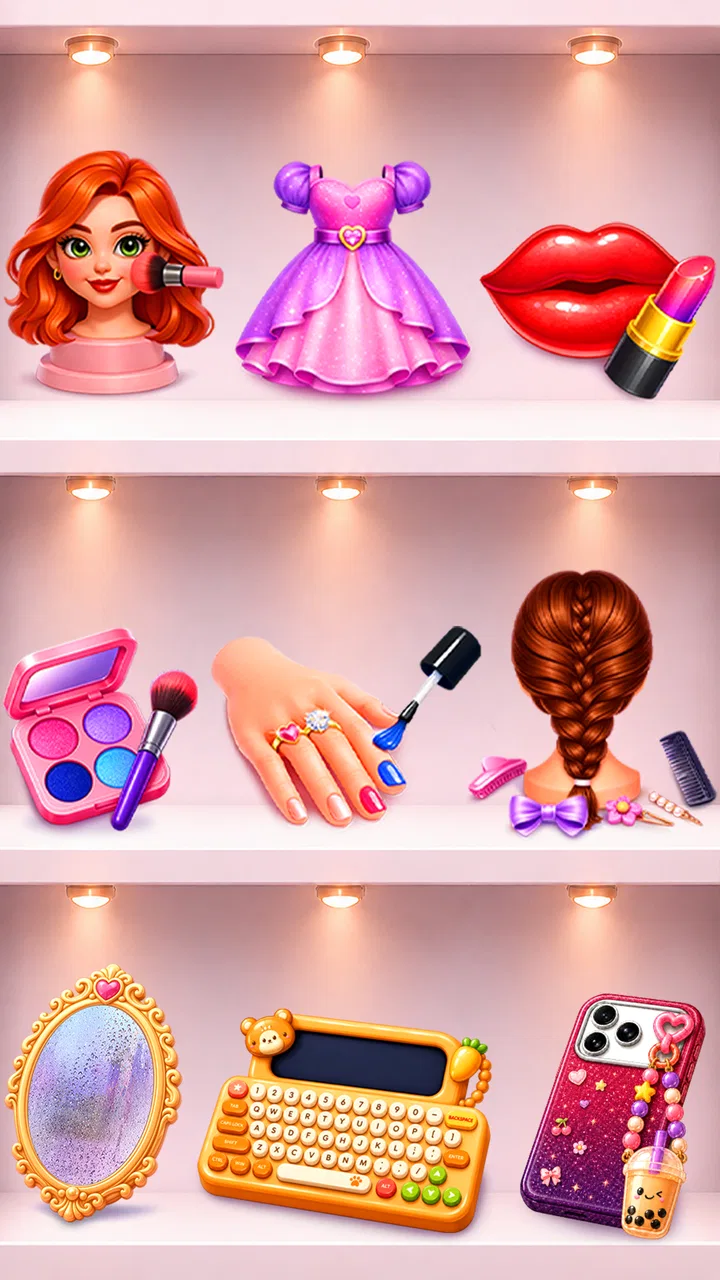
Mini Dress Up & Beauty Games
- 4.5
- Rating
- 10.00M
- Installs
- Free
- Price

 Analysis by App-foxy
Mini Dress Up & Beauty Games is the kind of casual game I open when I want something light, colorful, and easy to understand immediately. It combines outfit styling, beauty choices, and puzzle-like mini activities in one short-session experience, so I never feel that I need to study a complicated rulebook before playing. The focus is clearly on creating looks and completing small challenges rather than building a long, demanding adventure.
My first impression was that it is aimed at players who enjoy fashion games but do not necessarily want a large social platform, a competitive ranking system, or a serious simulation. The appeal is in making quick choices, seeing a character come together visually, and moving through a collection of playful tasks. The game is free, rated for Everyone, and belongs to the casual category, which makes it a natural fit for children, families, and adults who want a relaxed distraction.
Getting comfortable with the fashion-and-puzzle format
The game comes from Toy Tap LLP and has attracted more than a million installs, with an average rating of 4.6 from around 4.6 thousand ratings. Those figures suggest that its simple presentation has found a broad audience, but I would not mistake that popularity for a promise that every player will enjoy it equally. Someone looking for deep character customization or a long-term competitive challenge may find the experience too gentle.
You May Also Like

 Blood Strike: 2.5 Anniversary
Blood Strike’s Loadouts Turn Every Drop Into a Tactical Gamble
A close look at Blood Strike’s custom loadouts: how fast access to signature weapons reshapes its battle royale rhythm, rewards preparation, and narrows the gap between fights.

 Pandora - Music & Podcasts
Pandora’s Music Is Easy to Start, but Harder to Recover
Pandora’s strength is its low-effort path from a seed to a station. Its weak spot is how much confidence it asks you to place in connection, setup, and quiet recovery.

 8 Ball Pool
 Is Built on Rivalries, Rematches, and Routine
A close look at the rivalries, rematches, shared routines, and unanswered safety questions that turn a quick pool match into a persistent mobile community.

 Samsung Music
’s Quiet Strength Is Playing What You Already Own
Its reach comes less from spectacle than from dependable access to a personal library. That simplicity is both the app’s strongest retention engine and its ceiling.

 AccuWeather: Weather Radar
AccuWeather Review: A Quick, Clear Forecast for Everyday Decisions
For everyday plans, the best forecast is the one you can understand quickly. AccuWeather makes rain timing, radar, and local conditions easy to act on, with a few trade-offs.

 Hill Climb Racing
Why Hill Climb Racing Still Turns Crashes Into One More Run
A tiny car, a bumpy hill and one more upgrade: Hill Climb Racing keeps resurfacing because its simple chaos makes every near-miss feel personal.
More From Our News Desk



What I like most is the clear connection between the different parts. Fashion and beauty selections are not presented as unrelated menus; they form the visual reward for working through the mini-game structure. That gives each small decision a purpose. I can start with a basic look, make a few changes, and feel that I have completed something rather than merely browsing a catalog.
The short description calls it “Mini Dress Up,” and that is a useful way to set expectations. This is not a full wardrobe simulator with an elaborate story. It is better understood as a compact collection of dress-up moments with puzzle energy. The experience works best when I treat each session as a small creative break instead of expecting a large progression system.
Who will enjoy it most
I would recommend it to players who like choosing colors, clothing combinations, beauty details, and overall presentation without pressure. It is especially suitable for a first-time player who wants controls that can be understood through tapping and visual feedback. A child can approach it as a playful styling activity, while an adult may enjoy it as a few minutes of low-effort relaxation.
It is also a reasonable choice for someone who likes switching between creative and puzzle-oriented play. Pure dress-up games can sometimes become repetitive because the player only selects items. Here, the mini-game framing helps break up that rhythm. Conversely, players who prefer action, exploration, strategy, or a strong narrative should probably choose a different casual game. The fashion theme is the center of attention, not a decorative side feature.
What I do after installing it
When I begin a new game like this, I avoid trying to perfect the first character immediately. I first look at how the screen responds to taps, whether selections can be changed easily, and what the game considers a completed action. That approach is useful here because the first few moments are less about making a flawless outfit and more about learning the relationship between the mini-games and the styling choices.
I start by following the visible prompt rather than tapping every option at once. If the game presents a beauty or clothing decision, I make one choice, watch for the visual response, and then continue. This keeps the opening manageable and makes it easier to notice which elements are interactive. For a younger player, this is also a comfortable way to learn without needing an adult to explain every screen.
The current version is 0.4.8, and it runs on devices using Android 7.0 or later. That broad compatibility is helpful for people using an older Android phone, although the practical experience can still vary depending on the device’s screen, speed, and available storage. I would install it when connected to a reliable network, then give the opening sequence a few uninterrupted minutes instead of judging it from the first tap.
How to reach the first satisfying result
The first meaningful success is not necessarily creating the most fashionable look. For me, it is completing an early mini-game and seeing the character’s appearance reflect the decisions I made. I recommend choosing deliberately rather than rushing through every prompt. Even when the choices seem small, paying attention to the requested task helps the final result feel earned.
A useful habit is to treat each outfit as a quick experiment. I might begin with one clothing direction, add a beauty choice that supports it, and then check whether the overall appearance feels consistent. If the result looks too busy, I change one element instead of rebuilding everything. This one-change-at-a-time method makes the game easier to understand and prevents the styling process from becoming random tapping.
Another practical tip is to pause after a puzzle action before making the next fashion decision. The game’s visual feedback can be easy to overlook when I move too quickly. Waiting for the screen to settle lets me see whether I completed the intended step and whether the next choice is part of the same activity or a new one. That small pause is particularly useful for first-time players.
For a child, I would frame the first session as a creative task: choose a look, explain why the colors or accessories work together, and then try a different combination later. This turns the game into more than a sequence of taps. It encourages observation and personal preference without making the player feel that there is only one acceptable style.
Where new players may hesitate
The biggest possible source of confusion is the boundary between the puzzle activity and the dress-up activity. A player may assume that every screen is simply a wardrobe menu, while another may focus on solving the mini-game and overlook the styling choices. I found it easier to think of them as two connected steps: complete the immediate task, then use the fashion and beauty options to shape the result.
It is also easy to believe that the most decorated character must be the best one. I do not think that is a useful assumption. Adding more visual elements can make a look feel less coherent, so I prefer to decide on a general direction first. A simple outfit with matching details often feels more successful than selecting every available option.
Another point worth remembering is that a casual game can still have a learning curve, even when the controls are simple. If a tap does not produce the expected result, I check whether the game is waiting for a particular choice or whether I have moved past the active part of the screen. Repeating the same tap quickly rarely helps; slowing down and reading the visual cue usually does.
Because the game is suitable for Everyone, I would still use ordinary family judgment when handing it to a young child. The age label makes it approachable, but children can differ greatly in how independently they navigate menus and understand game objectives. Sitting together for the first session is a good way to see whether the instructions and pacing suit that particular player.
A realistic everyday session
Imagine having ten quiet minutes while waiting for an appointment. I would open the game, complete one short activity, and spend the remaining time adjusting the look rather than trying to force a long play session. That is where the format makes sense: it gives me a contained task with a visible result, and I can stop after finishing a styling moment without feeling that I have abandoned a complicated storyline.
It can also work as a shared activity between an adult and a child. One person can suggest a theme, while the other chooses the clothing and beauty details. The game provides enough visual material for conversation without requiring fast reactions. However, I would not choose it for a group that wants simultaneous multiplayer interaction, because its appeal is centered on individual decisions and personal presentation.
For a fashion fan, a more useful routine is to create two contrasting looks during separate sessions. Instead of repeatedly making nearly identical choices, I might deliberately try a softer combination first and a bolder one later. This makes the available styling decisions easier to compare and gives the mini-game structure a little more variety.
How it compares with familiar alternatives
Compared with a traditional dress-up app, this game has more of a task-based rhythm. A standard wardrobe app may be better if I want to browse clothing freely for a long time without interruptions. Mini Dress Up & Beauty Games is more suitable when I want the styling to be connected to short challenges and a sense of completing an activity.
Compared with a puzzle-only casual game, it offers a stronger visual reward. Solving a small challenge is followed by an expressive character result, which gives the session a more personal feel. The trade-off is that players who care mainly about logic may find the fashion layer less interesting, while players who care mainly about clothing may wish for a larger and more detailed wardrobe experience.
It also differs from large fashion games that emphasize social sharing, collections, or extensive progression. The compact approach is less intimidating and easier to pick up, but it may not provide the same depth for someone who wants a long-term hobby. I would choose this one for accessibility and short sessions, not for a highly involved fashion-management experience.
Small habits that improve the experience
I get more from the game when I make a decision before touching the screen. Choosing a color family, a mood, or a simple style goal gives the session direction. Without that intention, it is easy to tap through options and finish with a look that feels assembled rather than designed.
I also recommend changing only one category at a time when refining a character. If I alter clothing, hair, and beauty details together, I cannot tell which change improved the result. Adjusting one element makes the visual feedback more useful and turns the game into a small exercise in comparison.
A third tip is to stop after a satisfying completion instead of continuing automatically. The game is strongest as a short, repeatable activity. Playing beyond the point of enjoyment can make any collection of mini-games feel repetitive, while returning later with a new styling idea keeps the format fresh.
Parents and first-time users may also appreciate starting with a shared goal rather than a performance goal. Asking “Which look feels most like your idea?” is more useful than asking whether the character achieved a perfect score. That approach matches the game’s friendly, creative tone and avoids turning a relaxed activity into an unnecessary test.
Where the game may fall short
Its simplicity is both the main strength and the main limitation. I can understand the basic appeal quickly, but I should not expect the complexity of a full fashion simulator. Players who need detailed customization, layered storytelling, or demanding puzzle design may run out of novelty sooner than casual users.
The format may also feel repetitive if I approach every session in exactly the same way. The best defense is to vary the styling goal and pay attention to the puzzle portion instead of treating it as an obstacle between wardrobe screens. Even then, someone seeking constant new mechanics should look toward a more ambitious game.
Another limitation is personal taste. The bright, girly presentation will work well for players who enjoy beauty and fashion themes, but it will not appeal equally to everyone. I would skip it if I wanted neutral visuals, realistic simulation, action, or a story-driven experience. The game knows what it wants to be, and that focused identity will naturally exclude some audiences.
My recommendation for a first-time player
I would install it when I want a free, approachable casual game that combines styling with small puzzle moments. My suggested path is simple: open the first activity, follow the visible instruction carefully, make one clear fashion choice, and then refine the result rather than trying to use everything at once. That sequence gives a new player an early success without making the opening feel complicated.
After that, I would decide whether the rhythm suits me. If I enjoy the combination of quick tasks and visual creation, the game is easy to return to during short breaks. If I find myself wishing for deeper wardrobes, longer challenges, or more strategic play, that is a sign that a larger alternative would be a better fit rather than a failure of this particular title.
My overall view is positive, with realistic expectations. Mini Dress Up & Beauty Games is at its best as a friendly, low-pressure fashion break, especially for first-time players and families who want an accessible activity. Toy Tap LLP keeps the concept focused on beauty, clothing, and casual mini-game fun instead of overwhelming the player with systems. I would recommend it to anyone who enjoys making quick visual choices, while advising more demanding players to look elsewhere for depth.
The free entry point and Everyone age rating make it easy to try, and the broad Android support helps older-device users consider it as well. Just remember what you are downloading: a compact dress-up experience with puzzle flavor, not a massive fashion world. Used in that way, it delivers a pleasant first success quickly and gives casual players a simple reason to come back.
FAQs for Mini Dress Up & Beauty Games
01What age group is Mini Dress Up & Beauty Games suitable for?
Mini Dress Up & Beauty Games is designed for children aged 4 and up. The app offers a kid-friendly interface and engaging content that encourages creativity and imagination. Parental controls ensure a safe environment, making it suitable for young users who are interested in fashion and style games.
02Does Mini Dress Up & Beauty Games require an internet connection to play?
No, Mini Dress Up & Beauty Games can be enjoyed offline. Once the app is downloaded, all the features and mini-games are accessible without an internet connection, making it convenient for long trips or areas with limited connectivity.
03Are there in-app purchases in Mini Dress Up & Beauty Games?
Yes, the app includes in-app purchases. While the base game is free, additional content such as premium outfits and accessories can be purchased to enhance the experience. Parents can manage and restrict these purchases through their device settings.
04Is the app available on both Android and iOS platforms?
Mini Dress Up & Beauty Games is available for download on both Android and iOS devices. Users can find it on the Google Play Store and the Apple App Store, ensuring a wide accessibility across different devices.
05How can I report a problem or provide feedback about the app?
Users can report issues or provide feedback directly through the app's support section. Additionally, contacting the developer via their email or official website can be an effective way to communicate concerns or suggestions for future updates.
Pros
- Wide variety of outfits and accessories.
- User-friendly interface for easy navigation.
- Regular updates with new content.
- Engaging mini-games enhance experience.
- Offline mode available for uninterrupted play.
Cons
- Contains ads that may interrupt gameplay.
- Limited free content; in-app purchases needed.
- Some features require a stable internet.
- Occasional lags on older devices.
- Customization options can be overwhelming.

Mini Dress Up & Beauty Games
Gallery